Imagine you are at the edge of the sea on a day when it is difficult to say where the land ends and the sea begins and where the sea ends and the sky begins. Sea kayaking lets you explore these and your own boundaries and broadens your horizons. Sea kayaking is the new mountaineering.
Wednesday, August 14, 2013
Better Days #15, on Gigha
We found this sad old wooden clinker rowing boat in the undergrowth above the beach at Port an Duin on Gigha. I rather liked the look of her lines but sadly she has seen Better Days.
Tuesday, August 13, 2013
Trouble at the mill on Gigha.
At the northern end of Cnoc Loisgte a sudden break in the rocks appears. It is called Port an Duin, landing place of the fort. A sheltered inlet is created by a small island which sits at the mouth of a small bay below an old dun or fort. These goslings were enjoying the shelter. I had first paddled round Gigha 10 years previously and...
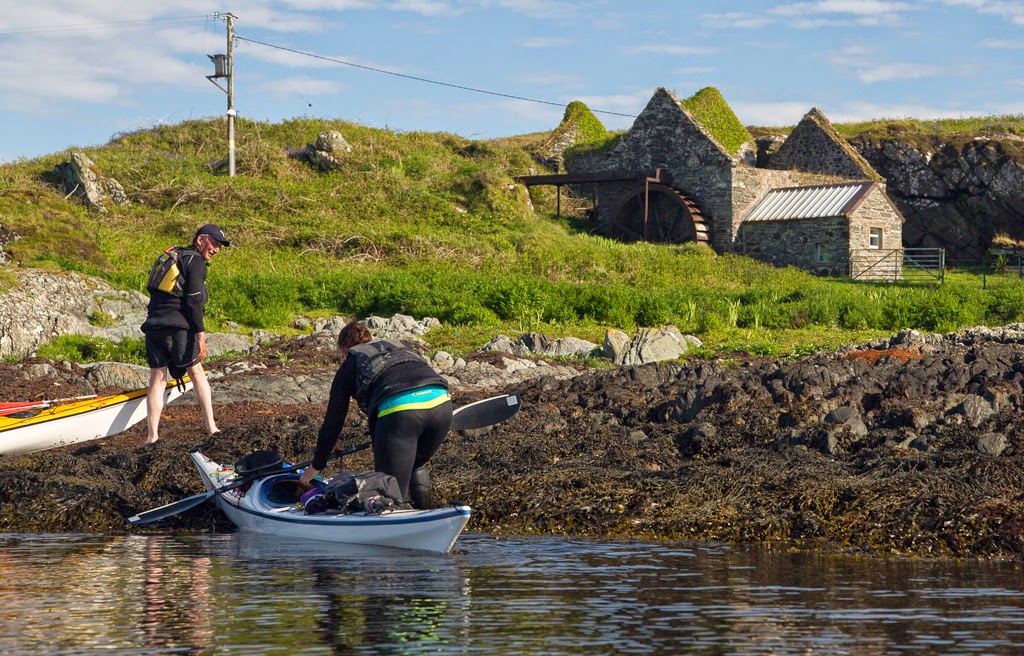
...had always wanted to land and explore the old mill. I have visited at least once a year since then but have always been thwarted from landing by either the swell (or midges). At last suitable weather conditions allowed a landing but my troublesome left knee let me down. Low tide revealed a sloping slab covered in slippery seaweed. There was no way I would get across unaided. Fortunately Mike and Phil came to my help and escorted me safely to a the shore.
It was well worth the trip. The mill is nearly 200 years old, dating from the early 19th century.
The cast iron lade and...
... overshot 16 foot water wheel are still complete.
The axle runs through the north wall of the mill and...
...connects to a gear wheel on the interior, which was used to drive the mechanism. The millstones are on the floor under that tangle of undergrowth.
On the mill's east wall the grain shoot is still in existence. Oat grains were poured from sacks which were stored on a higher building on the...
...uphill side of the mill. What a fascinating spot. Thanks again to Mike and Phil for helping me see it.
...had always wanted to land and explore the old mill. I have visited at least once a year since then but have always been thwarted from landing by either the swell (or midges). At last suitable weather conditions allowed a landing but my troublesome left knee let me down. Low tide revealed a sloping slab covered in slippery seaweed. There was no way I would get across unaided. Fortunately Mike and Phil came to my help and escorted me safely to a the shore.
It was well worth the trip. The mill is nearly 200 years old, dating from the early 19th century.
The cast iron lade and...
... overshot 16 foot water wheel are still complete.
The axle runs through the north wall of the mill and...
...connects to a gear wheel on the interior, which was used to drive the mechanism. The millstones are on the floor under that tangle of undergrowth.
On the mill's east wall the grain shoot is still in existence. Oat grains were poured from sacks which were stored on a higher building on the...
...uphill side of the mill. What a fascinating spot. Thanks again to Mike and Phil for helping me see it.
Monday, August 12, 2013
The great rock wall of Cnoc Loisgte, Gigha.
Once we left the shelter of the skerries, we encountered a small swell on the exposed west coast of Gigha. The presence of swell, even in the middle of a large high pressure weather system, shows how lucky we were to have had calm enough conditions to explore the SW corner of Gigha.
We now arrived at the great rock wall of Cnoc Loisgte, which translates as...
...the arid hill. Its unbroken ramparts stretched away almost as far as the eye could see. There were no landing spots either in front...
...we paddled steadily on until...
...a light breeze offered some assistance.
We now arrived at the great rock wall of Cnoc Loisgte, which translates as...
...the arid hill. Its unbroken ramparts stretched away almost as far as the eye could see. There were no landing spots either in front...
...or behind so...
...a light breeze offered some assistance.