As we made our way back to the beach at the north of Little Ross Island we could hear the sounds of guns of various calibres coming across the water. They were being fired at Dundrennan Firing Range (or Kirkcudbright Training Centre as it is now called). I had called the Range Officer on 07786 126151 (manned 24 hrs) prior to our departure so I knew the range would be closed and it would not be possible to continue east round the coast. The Range Safety boat, the Gallovidian III, was already moored off the north point of the island. From previous experience I knew that her skipper Gary McKie would up anchor and motor close inshore as soon as he saw us. So Ian called him up on Channel 16 to let him know our intended route, which was well away from the range.
After a cheery wave from the Gallovidian III we set off against a stiff wind up the west side of Kirkcudbright Bay.
Little Ross slipped astern as the flood spring tide assisted us against the wind.
Once clear of the range, we crossed the bay to the wooded shores of St Mary's Isle. An Augustinian priory was established here in the 12th century. Mary Queen of Scots stayed at the priory in 1563 while enroute to Dumfries from Kenmuir Castle near New Galloway. Legend has it that her party was benighted as they approached Kirkcudbright. Her escort was disinclined to risk her safety in the town's inns so they made their way here. In 1568 Mary came this way again after her defeat at the Battle of Langside near Glasgow. She spent her last night in Scotland at nearby Dundrennan Abbey before fleeing to England by boat from Port Mary and capture by Elizabeth I of England.
The lee of St Mary's Isle was a great place to catch our breath.
Further up Kirkcudbright Bay near Gibbhill Point we came across the wreck of this old wooden trawler. It had seen better days.
Imagine you are at the edge of the sea on a day when it is difficult to say where the land ends and the sea begins and where the sea ends and the sky begins. Sea kayaking lets you explore these and your own boundaries and broadens your horizons. Sea kayaking is the new mountaineering.
Wednesday, November 18, 2015
Tuesday, November 17, 2015
Little Ross lighthouse, a lens and an alpine garden.
As we left Little Ross Island cottages and climbed towards the lighthouse we saw we were in line with the leading mark for vessels leaving Kirkcudbright Bay. Surprisingly this was not illuminated until 2005. The increasing number of scallop dredgers leaving Kirkcudbright at night was the reason. The white tower just visible on the mainland is a range control tower for the Dundrennan Firing Range.
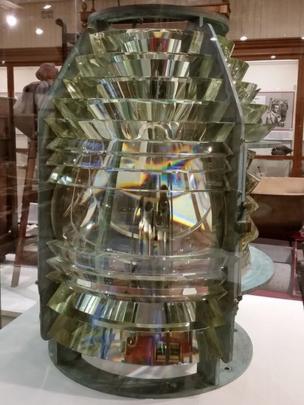
Little Ross lighthouse was first lit on 1/1/1843. The light flashes white every five seconds. It was the first lighthouse in the world to have a catadioptric design, which meant that the beam was focussed with both lenses and mirrors. At the time the famous physicist Lord Kelvin ranked it (along with the lighthouses at Rhinns of Islay and Buchan Ness) as one of the top three lighthouses in the World.
In 2004 the original lens was helicoptered to Kirkcudbright Museum but it was so heavy that it was only this year that it has been displayed properly.
The arch over the doorway proclaims that Little Ross lighthouse was built...
...in 1842 by Robert Stevenson and Robert Hume.
This nice bronze identifier is more recent!
The lighthouse shares a courtyard with the keepers' cottages. There were normally three keepers but...
...at the time of the murder in 1960 there were just two temporary keepers because the light was about to be automated.
The present owners have fitted this door bell but no one was at home.
We rested for a short time in the lee of the buildings. The early morning sun was warm out of the chill wind. At our feet...
...the cobbled courtyard was a veritable garden of miniature alpine plants and lichens.
The owners of the cottages have a lovely kitchen.
From the lighthouse we had a clear view SW across Wigtown Bay to Burrow Head some 22km away and the village of Isle of Whithorn to its right.
We were going north however and in The Sound we could already see the start of the flood tide. It was time to go...