Showing posts sorted by relevance for query hypothermia. Sort by date Show all posts

Monday, January 08, 2007

A chilling winter warning.


In my post about winter paddling at Ayr yesterday, Squidink asked about the water temperature. By coincidence, Grazie who publishes Skoogle recently posted an index link to a post I made on the Sea section of the UK Rivers Guidebook forum last winter. I take the liberty of reposting here as cold water is probably the greatest threat to the safety of any sea kayaker.

A chilling winter warning.
December 2005. Regular readers of this forum will know of my concern for falling into cold water. I personally use a dry suit with pile/pertex underneath in winter if it is rough or a two piece bib with dry feet and a cag with latex wrist seals and a sealable neck in more moderate conditions. Under the two piece I use polartec aquashell garements which are made of micro fleece bonded to a breathable waterproof membrane equivalent to but much more comfortable than 3mm neoprene. I have practised falling in during winter and both of the above work.

However, I got a very bad shock last Saturday (at the end of December). My brother Donald did a lot of kayaking in the late 60's early 70's but had stopped until September when I took him out in my Alaw at Arisaig in September. He has had several major life events recently and he enjoyed the escape of kayaking so much he gave up smoking! I hadn't seen him since then till last weekend but he phoned very keen to go out again. The Accuweather upper Clyde sailing forecast was for a 6 mph northerly dropping to 3mph. The BBC forecast was for sun and 7 mph northerly winds.

I decided to go to Largs and take him across to the Cumbrae. I thought if the weather changed he could always get the ferry back. I decided not to bring my regular paddling partners Jennifer or Mike along as I wanted to be able to concentrate on Donald. We arrived at Largs in a flat calm just as the sun was coming up. We met Billy an experienced kayaker who was down to test his new paddle. We decided to head across to the Cumbrae ferry terminal.


I was very surprised how much weight Donald had put on since stopping smoking. I wished I had brought the Quest for him rather than the Alaw which had been a good fit in September. But we removed the hip shims, got the footplate right to the front and got him squeezed in and showed him how to release the nylon spraydeck.

FIRST MISTAKE

The Alaw was now too small for him. We should not have gone.

I had brought him a Yak salopette with velcro neoprene ankle seals and a Yak cag with velcro neoprene seals at wrists and neck. I had also brought my 3 mm neoprene shorty wetsuit and thermals for underneath but the wetsuit was far too small for him. He ended up with two Helly Hansen long johns, 1 Helly Hansen top with a micro fleece and a normal fleece under the Yak gear. I finished him off with Chota neoprene knee length boots, neoprene gloves and a neoprene cap. He complained he was too hot!

We were soon paddling over a glassy sea but a dark line on the horizon soon changed everything and we had a force 4 NW wind channelling straight down the Kyles of Bute meeting a spring flood tide.


Donald was really enjoying himself but I asked him if he would like to turn back. He definitely didn't!

SECOND MISTAKE
I should have turned back straight away as the weather was now out with his recent experience. As I have been sailing, windsurfing and kayaking at Largs since 1967, I had little excuse for not appreciating how local winds funnel and accelerate down through valleys in the hills and between the islands.

We were soon in the calm of the lee of Cumbrae and were enjoying a cup of hot soup. We were planning what to do next. I suggested heading south in the shelter of Cumbrae but the wind further out had now definitely dropped and Donald had caught a glimpse of the hills of Arran behind Cumbrae and fancied a quick look round the north of the island to get some photos.

Billy and I let him lead the way and told him we would turn back as soon as he felt uncomfortable. As we rounded the point, the wind was continuing to drop so we continued round.


We headed out from shore a bit to get the best view over to Arran. Unfortunately we had not gone much further when another dark squall line appeared on the horizon. This time we all decided to turn for the shore at the same time. But it was soon on us blowing about 4 to 5 and the seas built up very quickly. Donald found the following sea much more difficult and I saw him do a couple of successful low braces. I wondered if I should raft up with him.

THIRD MISTAKE. As soon as I saw him brace I should have rafted. As we approached the shore the waves steepened, he broached and fell in 190 metres from the shore.


He was disorientated and had the cold water gasp reflex but I was right beside him and got him to hang onto my bow. I got his boat emptied in seconds while Billy calmed him down. We then got him in between his boat and mine facing towards his bow. He was getting very cold and he was moving very clumsily. I have practiced getting big people into boats before and found the best way is between the hulls, arms over both boats, feet into cockpit and limbo forward. Donald got his legs into the cockpit but even with Billy and me on either side, he couldn't get his bum on the seat (a combination of being uncoordinated, weak and the seat back folding forward under his bum as the elastic was too stretchy).

A breaking wave washed over us and he was in again, looking even colder. I could see he was now mentally slowing down, his speech and movements were becoming uncoordinated. I looked at the shore it was just over 100m away. I shouted to Donald to grab the back of my boat (he had no strength left to get on the back deck of the boat) and shouted to Billy to keep an eye on him in case he couldn't hold on. I then paddled hard for the shore. The GPS data shows that it was only 7 minutes from the fall in to the shore.

He could hardly stand and the freezing north wind was blowing up the beach with no shelter and making him more hypothermic by the second (he had lost his neoprene ca)p. Now at last, some of the planning began to go right. I got him into my Vango emergency shelter. Billy and I got his wet clothes off and he put on the Buffalo pile and pertex jacket and trousers I always carry for such a situation. He then put the Yak suit and boots back on top together with a spare Lowe Alpine cap (fleece and pertex). With three of us in the shelter and three flasks of hot soup down our necks we soon had a warm fug but it was over half an hour before he got warm again.

Once he was warm enough he walked round the point to a sheltered bay on the east of the island and I towed his boat round. In the sun and shelter we had lunch washed down with more hot soup (we had 6 flasks between the 3 of us).


Donald (on the left) was soon back to form and even wanted to paddle back to Largs. We did have another spare change of clothing but he sensibly decided to take the ferry back and I towed his boat back to Largs.

What if we hadn't been near the shore? We would have to have used a scoop rescue (we had two hand pumps and a portable electric pump between us to empty the boat after this) but even with 2 experienced kayakers, we might have found it difficult to get him into the cockpit. Once he was in, one of us would then have needed to raft up with Donald while the other towed. (We have practiced this.)

What if we had not been able to self rescue? Well I had VHF, flares and EPIRB and Largs RNLI Inshore Rescue Boat station was only 2.6km away. But Billy and I (we are both doctors) were amazed at how quickly Donald developed symptoms of hypothermia (and he has much more natural insulation than a thin person). He could have been seriously hypothermic by the time outside help arrived.

Billy who was not any better dressed than Donald has now ordered polartec aquashell wear for under his cag and salopettes. The water in the Clyde is currently 11 degrees C and deep water off the West coast never gets warmer than 13 degrees even at the end of summer. In Spring it could have been even worse. The temperature in the West coast Scottish sea lochs is then only 6.5 degrees C even although the sun and air temp might tempt you to paddle in shirt sleeves.

In conclusion, learn from my three main mistakes above. Although we had a satisfactory outcome, prevention is always better than cure. Anticipate problems rather than react to them. Know that cold water is a killer.

It has not put Donald off sea kayaking but next time he will be in a dry suit, in a Quest and in a nice sheltered loch!

All the best for a happy and safe season in 2007.

Friday, December 16, 2011

Kokatat GORE-TEX Expedition Dry Suit: long term test and review.

This is probably my most used bit of kayaking kit. My Kokatat GORE-TEX® Expedition Dry Suit is now entering its third winter, I bought it in October 2008. I own two other dry suits, a non breathable Dam X 3000 Series Kayaking Dry Suit,  which is very robust (ideal for WW kayaking, you can climb over barbed wire fences  and wade through thorn bushes on the way to the river in it) but for sea kayaking, it is too hot and inflexible to paddle any distance.  I also have a Palm Stikine, which is partially permeable to water vapour (breathable) but despite the best efforts of Palm's excellent warranty team, it is also partially permeable to water liquid (leaky).

Features.
The Kokatat has a front entry zip metal toothed zip which I initially found a bit awkward to start. Fully open, the zipper is high above your right shoulder. I keep the zip well lubed with zip lubricant and now have the knack to do it myself. The relief zip is worth every penny spent on it. There are handy zipped pockets on either shoulder with a security loop inside each. The only fault this suit has developed is that the stitching on one of these loops has become undone. These pockets will hold a small aquapac and I keep my car remote key in one and a small mobile phone in the other. There is another small pocket high on the left chest. There is a spray skirt tunnel that I never bother to use when sea kayaking. The latex gaskets show no sign of deterioration but I rinse the suit, inside and outside, with fresh water after every use making sure I give the latex a good wipe. Every few uses I wipe the latex with 303 Aerospace protectant, as recommended by Kokatat. The gaskets are protected from UV by being covered by cuffs at the wrists and neck. There is a GORE-TEX PacLite hood which is very well articulated so you can turn round without loosing vision. I don't use it often as I usually use a Lowe-Alpine Mountain cap in cold weather but it is really good in heavy rain or hail! The socks are also GORE-TEX and I get changed on a foam mat to avoid puncturing them on sharp grit underfoot. I use Lomo Aquaboots with this dry suit. The suit is reinforced on the seat, knees etc. and shows no sign of abrasion wear. A real feature of this suit is that it is not made in China in a factory powered by coal, it is made in the USA in an environmentally sound factory.

On the water.
The GORE-TEX material of the Kokatat suit is the most breathable I have worn on the water. This means that I can use it in warmer conditions than friends who have non GORE-TEX suits. In fact, I even use it in the Scottish early summer, when the water temperature is still cold. (I also use it in the Scottish late summer when the water has started to cool down again.) In June 2011 we went for an evening paddle along the SW coast of Dun in the St Kilda archipelago. I wore the Kokatat, a friend wore a two piece and swam after a swell broke over a reef. The resulting hypothermia drew that trip to an end. Interestingly, the paddler did have a dry suit on that trip, a Dam X, but did not wear it because it was too hot!

Paddling in winter a dry suit might keep you dry but it won't keep you warm on its own. You need to wear thermal insulation underneath. I use Fouth Element double layer Arctic fleece in the depths of winter. This will continue to keep you warm if it gets wet, after a suit tear for example. In spring and autumn I use Fourth Element single layer  Xerotherm fleece.

The cut of the Kokatat suit is so unrestrictive that I hardly notice I am wearing it, even when paddling hard. (A Kokatat Large is larger round the waist than a Palm Large.)

Even after practising rescues, my Kokatat is still bone dry in its third season. Because I have two very painful and unstable knee joints, which limit my mobility, I like having the added security of a dry suit. It might take me a bit longer to rescue/self rescue if I fluff a roll. Falling in to cold water is a real danger while sea kayaking. In spring especially, when the water is cold but the air temperature is higher, this Kokatat dry suit can still be worn comfortably in air temperatures in which other suits would have you boiling! It's even available in a choice of colours! You can have mango like mine or radish like my BA.

Just the weather for a dry suit, a cold NW wind with a wind chill of -7C.

Value for money.
It costs an arm and a leg but I think it has been one of my best sea kayaking purchases ever! In Scotland, you can get it from Sea Kayak ObanSystemX have recently been appointed UK distributor.

Overall score.
Score 12/10. It would have been 13/10 but for that security loop in a pocket coming undone!

Wednesday, September 07, 2011

Sea Kayak with Gordon Brown Volume 2 DVD preview.

I wasn't going to review Sea Kayak with Gordon Brown Vol 2 DVD for several reasons. Many of you will know I am friends with both Gordon and with Simon Willis, who has produced, directed and edited the DVD.  Also, I appear in the expedition section as I was lucky enough to be on the voyage to St Kilda aboard the MV Cuma that features in the DVD (as a full fare paying passenger). However, now that I have have made a declaration of interest, I feel better and you can keep it in mind to judge whether I am being objective or not.

Almost exactly two years ago, I published one of the first reviews of Sea Kayak with Gordon Brown Vol 1 DVD. In it I said that it had achieved a new standard for sports technique videos. I was not surprised when it went on to win several awards.

I have watched the preview of Sea Kayak with Gordon Brown 2 many times and it has raised the bar yet again. This is no dull technique DVD, filmed on flat water, there is a great deal of white water in this DVD! The technique section is divided into 8 parts covering up to date ideas on handling rescue situations and towing. The filming has been done in the environment and weather conditions that developing sea kayakers aspire to. It shows Gordon illustrating rescue and self rescue techniques while actually coaching students. Some of them, like Janice, are extremely long suffering! However, don't get the impression that Gordon is not prepared to get wet. Far from it, my heart was in my mouth watching him swim his kayak ashore then launch again in heavy surf, which was breaking into a rocky gully on the remote island of Cearstaigh off the coast of Harris. The final section on "anticipation and reaction" is designed to help you avoid the need to be rescued and builds nicely on the handling of a kayak in fast moving tidal waters that was introduced in DVD 1.

As with Volume 1, the filming and particularly the quality of the "on the water" sound recording is outstanding.  Volume 2 also features a journey, this time to the remote St Kilda archipelago, which lies 40 miles west of Scotland's Outer Hebrides. For me this is what makes this series of instructional DVDs unique. It is learning techniques in the context of and environment in which they will be applied. Ultimately sea kayaking is about the journey and learning the techniques, so clearly demonstrated in this DVD, will make your journey safer. During filming of the journey section, one of the team capsized and made a wet exit on the exposed SW coast of St Kilda. The rescue took seconds and a second rescuer was standing by to tow both rescuee and rescuer off the rocks if required. The paddler had not been dressed for immersion and quickly began to feel cold but a variety of spare over-cags, hats and gloves were produced to prevent hypothermia and the planned route was changed, given the weather conditions and the rescued paddler's condition. It was a wonderful, unrehearsed demonstration of the effectiveness of the techniques demonstrated earlier and more importantly the overall leadership and planning required to paddle safely in a demanding environment.

St Kilda features throughout the DVD and there are interviews with both Hamish Gow, the first paddler to reach it and Donald Thomson, the paddler who led the party which made the first return crossing.  The DVD is enriched by cine film of St Kilda shot by Gow in the 1960's. His description of his navigational method is a treat, though it might not feature in the BCU 5* syllabus!

I think that kayakers of all levels will learn from this DVD. Each time I have paddled with Gordon Brown I have come away with the confidence to take on more challenging conditions when paddling on my own trips. Sadly not every sea kayaker can have personal coaching from Gordon but this DVD is the next best thing. Sea Kayak with Gordon Brown Volume 2 is the result of a unique synergy between a coach at the top of his game and a talented film maker, who is himself a sea kayaker. I expect to see this DVD win several more awards for Gordon and Simon.

The DVD is due to have its first public showing at Paddle 2011 the Scottish Canoe and Kayak Show on 22nd/23rd October 2011. It will be available for purchase at the show and thereafter at www.seakayakwithgordonbrown.com

The cover of the preview DVD included this contents information:


ASSISTED RESCUES
The deep water rescue in detail. Also the scoop rescue for an injured kayaker.

SELF RESCUE FOUNDATIONS
Gordon’s coaching programme will help you teach yourself this vital skill.

SELF RESCUES
Starts with paddle float straddle and leg hook and leads on full re-enter and roll.

TECHNICAL LANDINGS
Heart stopping footage of landing and launching safely on  wave swept shores.

CONTACT TOWS - Watch Online
Making and modifying contact tows, plus their correct use in calm and rough water.

DISTANCE TOWS
Modifying and using tow lines. Using for rafted and ‘dog-lead’ tows on injured kayakers.

RESCUE SCENARIOS
Kayakers tackle challenging real-life rescue scenarios.

ANTICIPATION & REACTION
Rough water paddling skills to help you avoid the need to be rescued or towed.

Thursday, February 14, 2013

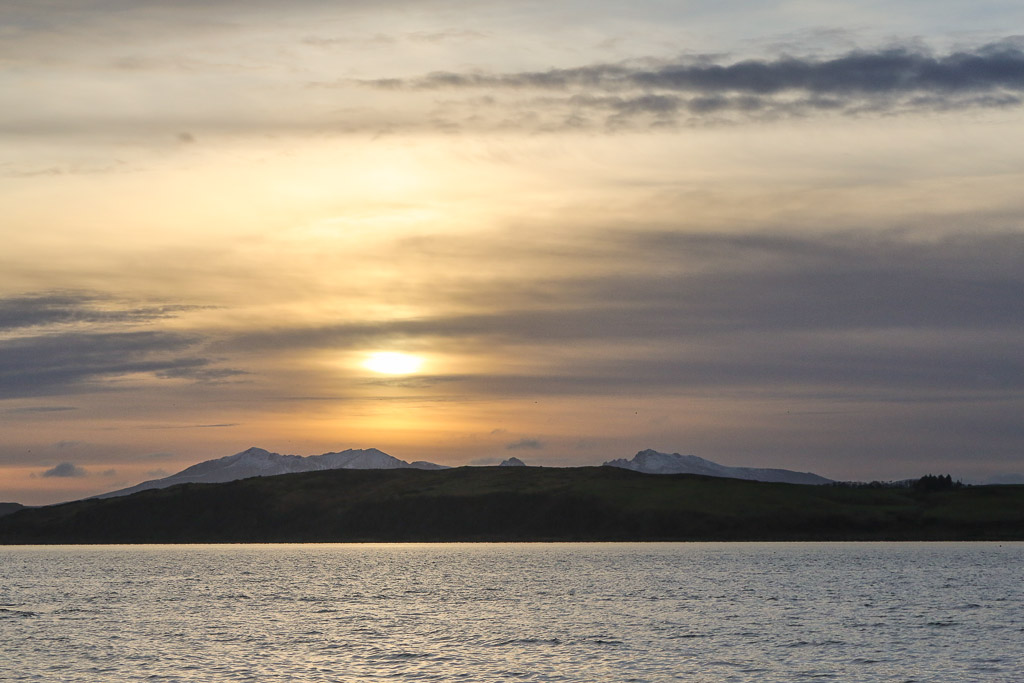
Winter sunset over the Cumbraes.

 Leaving the Eileans and their grey seal colony we set off on our return journey to Largs.

The fair isle of Little Cumbrae and the mountains of Arran gradually...

 ...slipped astern as the sun began to set in the SW.

 Once we rounded Farland Point on Great Cumbrae...

 ...the sun developed a warm reddish tinge but...

...don't be fooled it was bitterly...

...cold as we paddle sailed the last few kilometres...

 ...into Largs.

Surprisingly, given our late start, we arrived back before sunset. The Arran mountains were looking fantastic behind the rounded outline of the Great Cumbrae.

This was another fantastic trip. I am glad we did not launch at Ayr with our original intention of paddling south to Culzean. The NW wind on our arrival was a bit strong for mid winter paddling which is why we chose this route which was sheltered by the islands. While we were enjoying ourselves an unfortunate (but lucky) kayaker capsized in Culzean Bay and required hospitalisation for hypothermia after being rescued by helicopter.

Thursday, March 12, 2015

Kokatat GORE-TEX® Expedition Dry Suit, extended long term test and review.


My Kokatat GORE-TEX® Expedition Dry Suit is probably my most used bit of kayaking kit. In the West of Scotland I use it from October until June. I bought from Sea Kayak Oban in October 2008 so it is six and a half years old. Though since I was disabled for several months last winter, it has seen just over 6 years use. I bought it after owning three other dry suits which proved not breathable enough, too stiff to paddle in comfortably or leaked (or all three!). In a blog in December 2011 I did a 3+ year review and since I still use it I thought it was time for an update. I also did a long term review for the last issue of Ocean Paddler magazine (#45) but given publishing schedules, that was actually written some time ago. Since then I have returned the suit to System X for a service with interesting results and I now include those findings here.

Features.
The Kokatat Expedition has a front entry zip metal toothed zip which runs from right shoulder across and down to the left hip. I initially found it a bit awkward to start at the right shoulder but I soon got the hang of that. A friend bought a medium and found he could not do the zip himself and after several seasons gave it to his daughter and bought a large. He now has no trouble operating the zip himself, so this is something to bear in mind when choosing a size. The male relief zip is worth every penny spent on it. There is also a female drop seat version.

There are handy zipped pockets on either shoulder with a security loop inside each. These pockets will hold a small Aquapac and I keep my car remote key in one and a small mobile phone in the other. There is another small pocket high on the left chest. There is a spray skirt tunnel that I never bother to use when sea kayaking. The gaskets are protected from UV by being covered by cuffs at the wrists and neck.

There is a GORE-TEX PacLite hood which is very well articulated so you can turn round without losing vision. I don't use it often as I usually use a Lowe-Alpine Mountain cap in cold weather but it is really good in heavy rain or hail, even on top of the alpine cap! If the hood is rolled and secured by its velcro strap it does not get in the way of rolling (but I would not use a suit like this in a grade 3+ WW river environment). If the hood is unsecured it does not particularly impede a lay back roll but it does fill with water and make forward finishing rolls difficult.

The socks are also GORE-TEX and I get  changed on a foam mat to avoid puncturing them on sharp grit underfoot. I use Lomo Aquaboots with this dry suit as they have a gusset behind the zip which prevents sharp sand sand and fine grit (which might puncture the socks) from entering the boot. The body of the suit is made of GORE-TEX reinforced in places such as the seat, knees etc. with cordura. The GORE-TEX material is thinner, softer and much more flexible than breathable laminate materials I have used in other suits. It's even available in a choice of colours. You can have mango like mine or radish! A real feature of this suit is that it is not made in China in a factory powered by coal, it is made in the USA in an environmentally sound factory.

Maintenance
I rinse the suit, inside and outside, with fresh water after every use making sure I give the latex a good wipe then peg it upside down to drip dry in the shade. After about an hour I hang it up the right way in a well ventilated garage. I find that the suit is so breathable that I do not need to turn it inside out to let the inside dry like my other "breatheable" suits. About every 5 to 10 uses I cold machine wash the suit using Nikwax Tech Wash followed by Nikwax TX direct wash in proofer. I give the suit a cool iron (with a cotton cloth between the suit and the iron) to reactivate the water resistant finish. I then wipe the latex seals with 303 Aerospace protectant, as recommended by Kokatat. I keep the zip well lubed with zip lubricant.

Wear and tear.
The only fault this suit has developed is that the stitching on the little security loops in the shoulder pockets has become undone. The first loop parted company after 6 months, the second after four years. The only apparent wear points on the suit are two small abraded areas on the inside of the upper arms where the suit has been rubbing on my Kokatat MSFit Tour BA (I know this is the female version of the OutFit Tour but the latter has the radio pocket in the middle and I don't like the aerial up my nose).

The latex gaskets lasted 5 years before they began to show first signs of perishing. The rubber became sticky and stuck to itself especially at rolled edges. At 5.5 years old, I had the seals replaced by "The Rubberman". I sent him the suit on Tuesday and got it back on the Friday of the same week. He also pressure tested the suit and found only one small leak under one of the abraded areas on the inner arm. He fixed this with a small rubber patch on the inside.) The suit has faded a little but not as quickly as some of my other items of sea kayak clothing or my other dry suits.

At six and a half years old my suit was still bone dry in normal paddling but I did notice that if I waded into the water to take photos there was some localised dampness on the front of my thighs although my bum and feet remained dry. I returned my suit to System X for pressure testing.

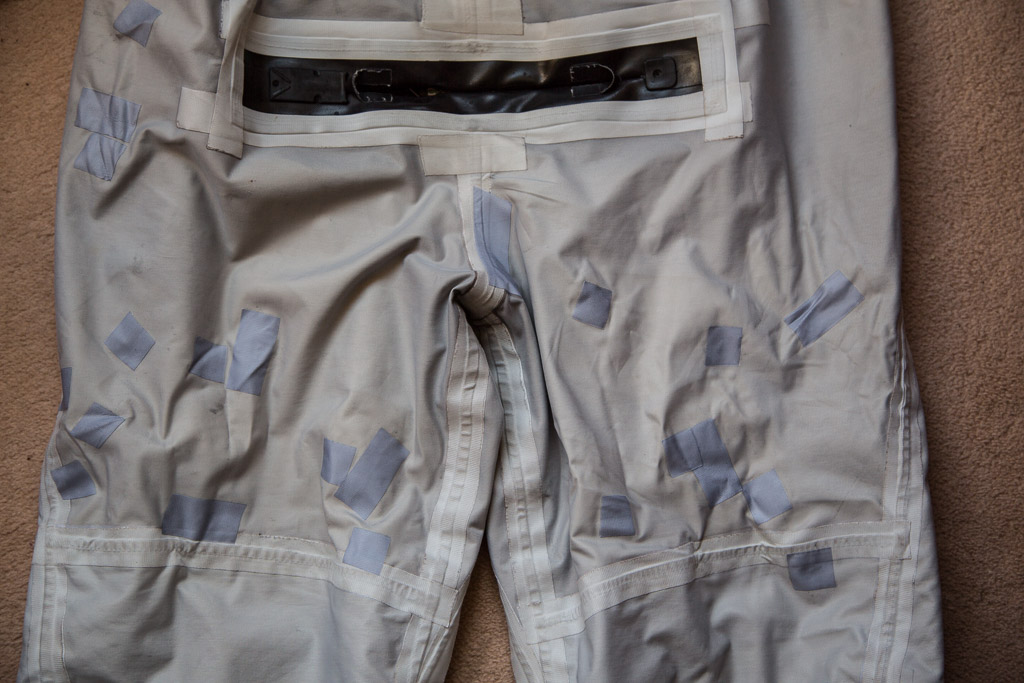
System X found approximately 75 pin hole leaks most of which were clustered on the front of the thighs. Each leak is repaired with GORE-TEX approved patching material. They even removed and replaced the rubber patch which the Rubberman had used the year before. I suspect that The Rubberman had only repaired the largest leak and missed many of these smaller pinholes. System X charge £40 for pressure testing a suit, up to 100 patches and that even includes postage back to you!

I think that it is remarkable that a six and a half year old dry suit can be made completely waterproof again. It is a lot cheaper than buying a new suit! I fully expect to write an even longer term review of this suit in another three years and who knows after that...?. The only thing that System X could not do was replace the two missing security loops in the arm pockets of the dry suit.

It is interesting to see where the majority of pin hole leaks occurred  on this 2008 dry suit and also my 2005 Whirlpool bib, which I had serviced at the same time.
In both garments, they were clustered on the front of the upper thighs, above the area of cordura reinforcement at the knee. The pinholes have occurred  in the area where the suit is in contact with the thigh braces in my kayaks: Cetus MV, Aries 155, Delphin 155, Quest LV, Nordkapp LV and Rockpool Alaw Bach.

Perhaps Kokatat should consider extending the cordura further up the thigh?

On (and in!) the water.
The GORE-TEX material of the Kokatat suit is the most breathable I have worn on the water. This means that I can use it in warmer air conditions than friends who have non GORE-TEX suits. In fact, I even use it in rough conditions in the Scottish early summer, when the water temperature is still cold. In June 2011 we went for an evening paddle along the SW coast of Dun in the remote St Kilda archipelago. I wore the Kokatat, a friend wore a two piece and swam after a rogue swell broke over a reef. The water temperature was 9C and the resulting hypothermia drew that trip to an end. Interestingly, the paddler did have a dry suit on board the mother ship, a heavy non breathable suit, but did not wear it because it was too hot!

In the west of Scotland the sea temperature does not get much above 10-11C until the end of June...after the longest day!!! Falling into water that cold can kill so having a dry suit that you can continue to wear later in the season is a great safety benefit. Last year I accidental capsized on the way back from Ailsa Craig (which lies 14 kilometres offshore). It was the 21st of April, a lovely sunny spring day. On land the air temperature was 20C but the water temperature was only 7C. It was my first long paddle after my knee operation and my knee was agony. I put my paddle down and used my hands on the cockpit rim to lift my bum off the seat to stretch my leg out. A rogue wave came along and with my high centre of gravity... sploosh I was in! As I could not find the paddle I could not roll (and did I say I had the sail up?) Anyway a quick assisted recovery and I was on my way as if nothing had happened. That is what dressing for immersion means.

A week earlier on another sunny day with water temperature of 7C (but with a F4 wind) Mike and I met an "experienced" solo paddler wearing only a T shirt ( he was probably a member of the Darwin Kayaking Cub). We of course were wearing our Kokatat Expedition suits.

Paddling in winter a dry suit might keep you dry but it won't keep you warm on its own. You need to wear thermal insulation underneath. I use combinations of Kokatat merino and Fourth Element fleece of various thicknesses depending on the season. Even after energetic paddling this combination of fleece and GORE-TEX means that the fleece and socks never get wet with sweat. At the end of a session I can remove the suit and pack away my kayak and stuff just wearing the near dry fleece. I tend to use plain cotton boxer shorts under the fleece layers. At the end of a long day's paddle these are still dry. I could not use cotton shorts under the fleece in a non GORE-TEX suit as they would become soaked in sweat.

The cut of the Kokatat suit is so unrestrictive that I hardly notice I am wearing it, even when paddling hard. After practising rescues, my Kokatat is still bone dry. Because I have two very painful and unstable knee joints, which limit my mobility, I like having the added security of a dry suit. It might take me a bit longer to rescue/self rescue if I fluff a roll. Falling in to cold water is a real danger while sea kayaking and wearing a dry suit is a great backup if things go wrong.

In January this year we enjoyed a four day winter sea kayaking trip to Loch Leven, a sea loch that bites deep into the highest mountains in Scotland. In winter, the sun never rises above the mountains at the head of the loch. In the mornings the temperature was minus 12C and sea water was freezing to our paddle shafts. Despite the extreme cold, the Kokatat material remained flexible. Mike and I remained warm and dry in our Kokatat Expedition suits. Ian's non GORE-TEX suit was noticeably stiff and cumbersome in comparison and he was very cold. He had especially cold, wet feet caused by perspiration (not leaks as his suit was watertight if not breathable).

Ian ordered a new Kokatat Expedition on his return and as you can see, he is delighted with it.

Myself in a non Kokatat suit. Photo by Ian Johnston
On my most recent winter day on the water I was able to make a very useful comparison between the Kokatat and a popular competitor’s ‘breathable’ suit. I forgot my Kokatat drysuit but fortunately Ian still had his old suit in his car and lent it to me. I wore the same undersuit I usually do and although Ian's suit was not leaking, my undersuit and socks ended up wet with sweat and I felt very uncomfortable and cold, especially when we stopped. My feet were frozen. Unlike Ian who had never been more comfortable!

Myself in a non Kokatat suit. Photo by Ian Johnston
The borrowed suit was noticeably more restrictive than the Kokatat suit and I found it difficult reaching forward to my camera bag. Also, I could not plant my paddle blade as far forward as I usually do. I ended up with rashes under both arms. The suit I borrowed is very affordable but for serious winter paddling it just could not compete with the Kokatat for freedom of movement and comfort.

Value for money.
The Kokatat Expedition (currently £1,000) costs an arm and a leg but I think it has been one of the best sea kayaking purchases I have ever made. It represents true value for money and when it eventually wears out, which I do not think will be soon, I will replace it with another. That would hopefully last long enough to see me out! Two of my previous brands/models of drysuit currently cost in the order of £600. Both required replacement of panels within the the first twelve month guarantee period due to delamination. Each lasted three years until they became unusable due to extensive leaks caused by further delamination of the material at the seams. Both proved uneconomic to repair. I fully expect that my serviced six and a half year old Kokatat suit will last at least another 3 years for a current cost of £1000 + £40. I will let you do the sums and decide for yourself which represents better value for money. But it's not just about cost, the Kokatat's performance and comfort is noticeably superior to cheaper suits.

Summary.
The Kokatat Expedition dry suit is an unparalleled blend of freedom of movement, comfort, breatheability, dryness, durability and long term value for money.

Score 12/10. It would have been 13/10 but for the security loops in the pockets coming undone!