Wednesday, April 27, 2016

Sanctuary at Maclean's Skull Bay for the potato men of Glengarrisdale

The tidal flow along the NW coast of Jura always runs SW to NE so we were quite tired by the time we approached Glengarrisdale Bay. We really were in need of a break. There had been nowhere to land as the swell was breaking heavily on the rocks and sending spray high above our heads. to get some idea of the scale, you can just make out Iasn paddling to the right of the red roofed cottage.

 I had no worries about landing at Glengarrisdale as some islands and reefs protect the beach from the swell. Indeed former inhabitants had constructed a seawall of cobbles between the shore and one of the islands.

Glengarrisdale Bay was a Maclean stronghold in the mid 17th century. Their stone built fortification, Aros Castle, no longer remains but its site is marked by a solitary tree. The Macleans were defeated here by the Campbells in 1647.

The former shepherd's house was finally abandoned about 1947 and is now a well maintained MBA bothy. We hoped to spend the night here but as we approached we could see clothing airing on the line and a tent pitched at its front. We feared that it might be full.


However we found only a charming young couple, Tom and Frances, who were walking round Jura's coast (a grade 10 walk!!!). They had chosen to camp so there was plenty room. So we hung our own things up to air and...

 ...soon had our stoves on for an evening meal while...

 ...Tom and Frances climbed to the top of the hill behind the bothy to watch the sunset.

We three were so knackered that we delighted in just watching the sunset from the door of the bothy while a full moon rose high in the sky.

Away to the NE, Scarba and the Corryvreckan brooded over the Glengarrisdale shore. Like many places in Scotland, today's peaceful Glengarrisdale had a bloody past. Its alternative name is...

...Maclean's Skull Bay. A gruesome skull and femurs sat on a rock at the edge of the bay for many years. They disappeared in the 1970's. The skull had a "sword" cut in it and allegedly belonged to one of the defeated Macleans from the 1647 battle. Modern legend says it was situated in Maclean's skull cave at the east of the bay. However, in John Mercer's book "Hebridean Islands, Colonsay, Gigha, Jura" published in 1972, the above photo shows the sad relics on a rock at the west end of the bay. Their current whereabouts are unknown.

 As night fell we got the bothy fire going, We had brought a bag of charcoal some wood and a saw. The estate had left some large logs which we warmed ourselves by sawing.

Tom and Frances joined us at the fire and we swapped outdoor tales. This was their second night at the bothy and both had had a strange dream the night before. Quite independently they had dreamt of men bringing baked potatoes for the fire. It was with some satisfaction that Ian, Mike and I produced sweet potatoes wrapped in tin foil and placed them on the fire, we had plenty to share. Our new friends were amazed! Nothing beats a baked sweet potato with butter and pepper! From that moment on we were known as "the potato men of Glengarrisdale"!

Tuesday, April 26, 2016

A traverse of the Corryvreckan: "Beware of the flood in a sudden calm preceded by several days of strong west winds."

Slack water after the Corryvreckan flood was at 16:10 on 19/04/2017. To give ourselves time to get to the west end of the Corryvreckan where the incoming swell would meet the flood tide we set off from Port nam Furm at 15:24.

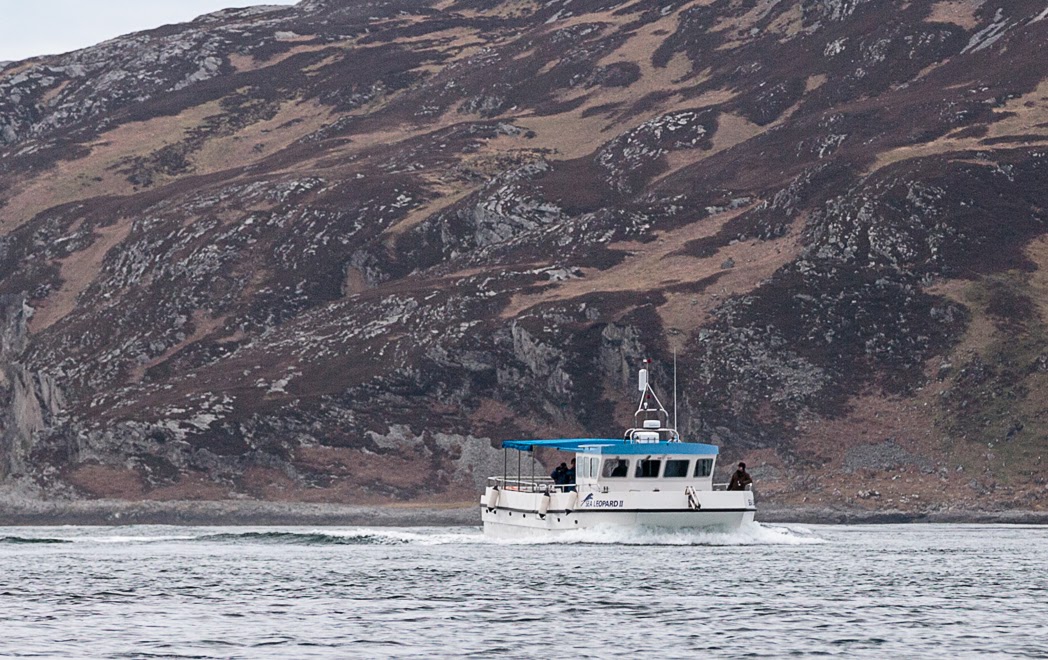
As we rounded the headland at the north end of Jura we came across the Sea Leopard II tour boat from Craignish Cruises.  Her alert skipper immediately throttled back to reduce her wake. This was very appreciated as wake combines with the Corryvreckan currents to produce very irregular waves. Several times in the Corryvreckan I have had to battle against such wake waves from thrill seeking power boats. To be fair I have never met anything but courtesy from the professional tour boats. Anyway after a big wave of thanks to the Sea Leopard II we set on our way.

Ahead, our eyes were now drawn to the open sea. I was quite glad that neither Ian nor Mike seemed to notice the large standing waves to our right which were forming over the pinnacle in the fairway of the Corryvreckan where the whirlpool forms.

It had been very windy from the west until the early hours of the morning, so we approached the west end with some trepidation. The pilot books warn: "Beware of the flood in a sudden calm preceded by several days of strong west winds. On the last of the flood an overfall can form as the tide meets the swell and form a solid wall of water across the Gulf." However, all was calm as we made our way through the narrowest part of the Gulf but...

 ...as we caught sight of the first of the islands on the south shore, we met the first of a series of large large swells that were marching in against the outgoing tide.

At this point the flood tide was still running west at 6km/hour though out beyond the islands it appeared to be approaching slack water.

 We were approaching the gap between Aird Bhreacain and Buige rock (just to the NW of the 68 on the map) and where the water is shallower when all of a...

...breaking standing wave reared up right across the channel. The tide was carrying me towards it at 6km/hour and there was no way round so I just dug my paddles in to pick up some momentum. I got a face full of water but I was safely through. As I was then left trying to clear my flooded sinuses I have no idea whether the others had to face the same. It was now 16:08 just about bang on slack and we had got through the Corryvreckan! However, the tide had now turned and was now trying to push us back into the Corryvreckan. I had set a destination waypoint on my GPS and the velocity made good fell until it was reading -1.6km per hour. Time for a sharp exit!

George Orwell nearly came to grief here in 1947 with his son, nephew and niece when his motor dinghy got swamped. Fortunately the tide carried them onto Eilean Mor where they scrambled up the rocks. Some hours later a passing fishing boat  plucked them to safety.

 After 2.5km of somewhat strenuous paddling we arrived in the shelter of Bagh Uamh nan Giall. We had made it through the Corryvreckan. I have traversed the Corryvreckan many times E-W W-E on both the north and south shores, NW-SE, SW-NE and straight through the middle. I have no doubt that exiting the SW corner is the most committing though in 2008 Tony and I had a somewhat thrilling entrance, W-E on the north shore while the west going flood was still in full pelt.

On that occasion we took advantage of an east going eddy that runs along the Scarba shore on the flood. This eddy then swings out from the shore into the vortex that forms the whirlpool! Your breaking out skills need to be pretty sharp to avoid ending up in the whirlpool!

I have written extensively on the geography, history, mythology, and route planning of the Corryvreckan in previous posts which you can read here.