Leaving the north channel of Loch Moidart we ignored the tempting sight of the Small Isles, Eigg and Rum and turned to the north where...
...we entered a turquoise lagoon where we...
...stopped for a well deserved second luncheon.
We had intended continuing north and spending the night in a bothy in the Sound of Arisaig but two events changed our mind. The first was a phone call from my wife telling me that a family member was undergoing a life threatening major surgical operation. The second was the MSI weather warning on the VHF. It warned of imminent gales and heavy snow. Although we would have chosen a bothy in a relatively sheltered position in Loch Ailort, the medical news left me no option but to turn back. Ian is such a gentleman that he made it very easy to make the decision. We looked back wistfully to the mountains in the north but we both knew that we would return.
We passed the hidden channel of the north entrance to Loch Moidart and the...
...the rocky ramparts of the west end of Eilean Shona before...
...rockhopping among the skerries and...
...channels to the hidden...
...sands of Ardtoe...
...which require maze solving skills...
...to finally find.
As a footnote, Ian and I faced blizzard driving conditions on our separate roads home and the March snows proved to be the worst of the winter with their drifts persisting well into April. Ian returned to his work at sea shortly but we will hopefully paddle again in late summer. Ian's account of this trip can be read here, here and here.
Imagine you are at the edge of the sea on a day when it is difficult to say where the land ends and the sea begins and where the sea ends and the sky begins. Sea kayaking lets you explore these and your own boundaries and broadens your horizons. Sea kayaking is the new mountaineering.
Sunday, June 16, 2013
Saturday, June 15, 2013
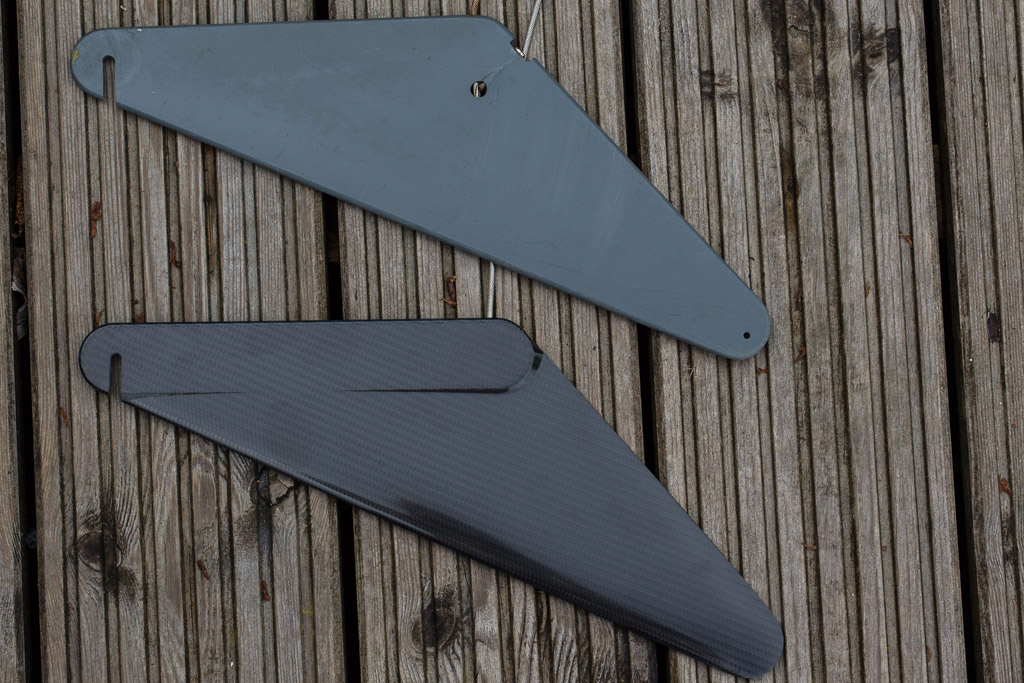
Carbon Fibre sea kayak skeg review and test.
Paddle sailing is a particularly satisfying aspect of sea kayaking and down wind you can hit speeds of over 20km/hr and frequently overtake the waves in front. Downwind the deployed skeg is very helpful to being able to paddle sail at maximum speed as you are not having to waste energy with steering paddle strokes. Most sea kayaks are fitted with plastic skegs of varying stiffness and form. Most are parallel sided with just a token rounding at the trailing and leading edges. Skegs like this are adequate for controlling weather cocking at normal paddling speeds of 5 to 8km/hr. However, at greater speeds I have found that some skegs hum, some seem to have little effect and some suddenly loose grip.
In comparison, the Valley skeg is just a flat piece of plastic. The Valley skeg is pretty low aspect and as it is made of thick plastic, I don't think the standard one will bend much anyway. However, what I would really like to see is Norbert making a high aspect skeg to replace the P&H one, which I think is too flexible. P&H kayaks like the Delphin and Aries have proved to be outstanding for paddle sailing and I think they are crying out for a stiffer skeg. Over to you Norbert....
Norbert's skeg has a similar outline to the standard Valley skeg but has a beautiful aerofoil shape and the standard of finish is stunning. I was very frustrated after I had fitted the skeg because further knee problems restricted my ability to paddle but after some highly successful physiotherapy following my last encounter with the orthopaedic knee surgeon I have taken to the water again (albeit maybe not for long as I have to see the shoulder surgeon next Wednesday and the knee surgeon in six weeks!)
Although I think Norbert's skeg feels more positive when paddle sailing, to be honest, I am not convinced it is much faster. However, if it prevents even one broach, you will be at least 100m ahead of your broached pal. Anyway what would you rather have hanging down from the stern, this beautiful skeg or a lump of grey plastic?
Any problems? Well when carbon fibre skegs started to appear on windsurfers there was a spate of torn out fin boxes as the existing design could not cope with the high lateral load of a fully powered up windsurfer travelling at high speed and a stiff unforgiving skeg. (In windsurfing you are balancing the full force of the sail by driving the force to the board through your feet. A great deal of the load goes through the back foot, which is usually very close (fore and aft) to the skeg.)
I don't think this will be a problem for sea kayak skeg boxes such as those made in the UK or the Cobra factory in Thailand as sea kayak skegs are much smaller and the speeds are much less than in windsurfing.
I can see that paddle sailors would be a market for skegs such as these. Also those people who buy carbon kevlar kayaks with beautiful clear hulls would surely love to have a matching skeg. I suggest Norbert contacts Valley!
I wish Norbert every success and if you would like to buy a carbon fibre Valley skeg you can contact Norbert on norbertga@o2.pl .
Friday, June 14, 2013
High and dry in Loch Moidart north channel.
At the east end of Shona Beag, the ebb tide was running strongly back down the south channel of Loch Moidart. once we rounded the end of the island we could see that the tide in the north channel was running east and joining the west flowing ebb in the south channel so I was pretty sure that the bar in the north channel would be dry.
My assumption was correct. High water in Loch Moidart was 08:54 and it was three days after springs. At 13:21 we were able to paddle right up to the causeway that the "road" runs over to Eilean Shona.
Looking west down the north channel from the causeway.
Looking east up the north channel after the short portage across the causeway. For any future trips I am pretty sure that 3.5 hours either side of high water in Loch Moidart should see you through without a portage. No time was to be wasted, not even for a drop of The Singleton. We remained quite dry as we raced to beat the tide.
The north channel was emptying quickly and water was extremely shallow for a considerable distance below the causeway...
,...so it was a great relief to enter deeper water.
The Sgurr of Eigg acts as a focal point at the far end of the north channel which is...
...hemmed in by steep rocky slopes. We called this balanced rock "the Mushroom".
The opening to the north channel is blocked by a series of low reefs and...
...green lagoons interspersed with...
...coral sand beaches.
Then we were clear, into the Sound of Arisaig with magnificent views to Eigg and the snow covered Cuillin of Rum beyond. Time for a swally *
* swally (n) a quenching of one's drouth.
My assumption was correct. High water in Loch Moidart was 08:54 and it was three days after springs. At 13:21 we were able to paddle right up to the causeway that the "road" runs over to Eilean Shona.
Looking west down the north channel from the causeway.
Looking east up the north channel after the short portage across the causeway. For any future trips I am pretty sure that 3.5 hours either side of high water in Loch Moidart should see you through without a portage. No time was to be wasted, not even for a drop of The Singleton. We remained quite dry as we raced to beat the tide.
The north channel was emptying quickly and water was extremely shallow for a considerable distance below the causeway...
,...so it was a great relief to enter deeper water.
The Sgurr of Eigg acts as a focal point at the far end of the north channel which is...
...hemmed in by steep rocky slopes. We called this balanced rock "the Mushroom".
The opening to the north channel is blocked by a series of low reefs and...
...green lagoons interspersed with...
...coral sand beaches.
Then we were clear, into the Sound of Arisaig with magnificent views to Eigg and the snow covered Cuillin of Rum beyond. Time for a swally *
* swally (n) a quenching of one's drouth.